

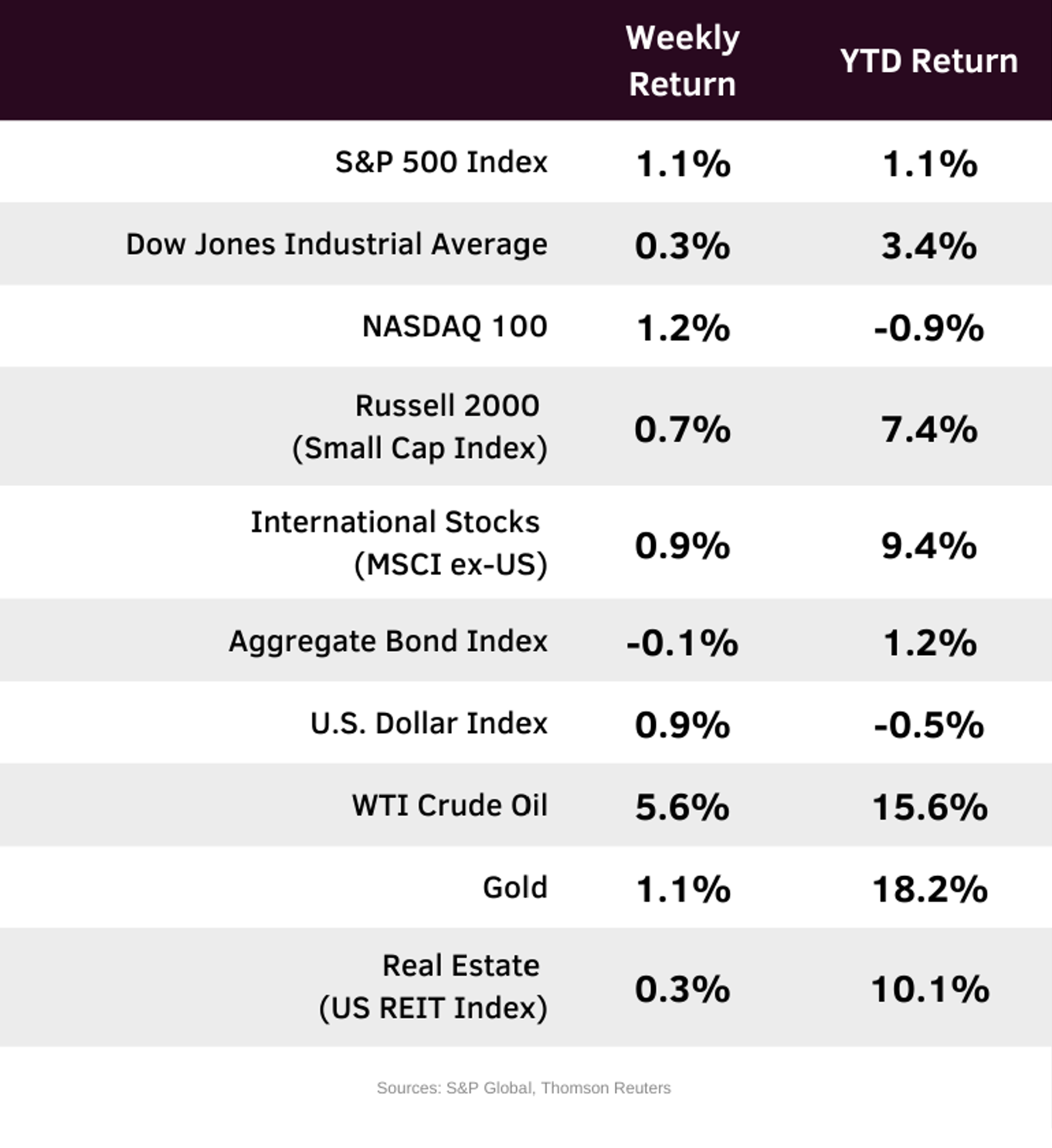
Equity markets rose on Friday to close higher for the week following the Supreme Court decision to overturn the Trump Administration’s use of unilateral emergency tariffs. For the week, the S&P 500 Index was +1.1%, the Dow Jones Industrials +0.3%, and the NASDAQ +1.2%. The Communication Services, Industrials, and Consumer Discretionary sectors led the S&P 500 Index for the week, while the Consumer Staples, Health Care, and Utility sectors lagged. The 10-year U.S. Treasury note yield was 4.082% at Friday’s close versus 4.051% the previous week.
Following the Supreme Court decision on the tariffs, the Administration announced a replacement across-the-board global tariff using Section 122 of the Trade Act of 1974, which allows up to 15% for up to 150 days to address large and serious balance of payments issues. Outside the tariff news, fourth quarter advance Gross Domestic Product (GDP) increased at an annual rate of +1.4% versus +4.4% in the third quarter. The government shutdown had a significant impact as federal spending contracted 16.6% and was a 1.15 percentage point drag on GDP. Both imports and exports contracted but were a net positive with a larger contraction in imports.
This week 55 companies in the S&P 500 Index scheduled to report earnings. Quarterly earnings are expected to grow by 13.2% and quarterly revenue growth is expected at 9.0% Full-year 2025 earnings are expected to grow by 13.3% with revenue growth of 7.5% and 2026 full-year earnings are expected to grow by 14.4% with revenue growth of 7.5%.
In our Dissecting Headlines section, we look at the Supreme Court tariff ruling.
Financial Market Update
Dissecting Headlines: Tariff Decision
In a 6–3 decision, the Supreme Court struck down the Trump administration’s sweeping global emergency tariffs imposed under the International Emergency Economic Powers Act (IEEPA), saying that the IEEPA does not authorize the President to impose tariffs.
The majority opinion, presented by Chief Justice John Roberts, cited that tariffs are “Duties/Imposts” tied to Congress’s Article I taxing power, and that allowing IEEPA’s broad language about regulating importation to support unbounded tariffs would require clear congressional authorization. The dissenting opinion, presented by Justice Brett Kavanaugh, criticized the majority’s reliance on the major questions doctrine, arguing neither the statutory text nor the Constitution supports invalidating the President’s action and that the Court was improperly narrowing executive authority in foreign economic affairs.
The ruling did not instruct the government to issue refunds, nor did it explain how refunds should work. That topic was explicitly left unanswered and returned to lower courts and administrative processes. Over $175 billion of collected revenue is at issue for refunds.
Following the decision, the Trump Administration announced a replacement across the board global tariff using Section 122 of the Trade Act of 1974, which allows up to 15% for up to 150 days to address large and serious balance of payments issues.
The Court decision and subsequent replacement tariffs announced keep the issue of trade and tariffs in flux for the near-term.