

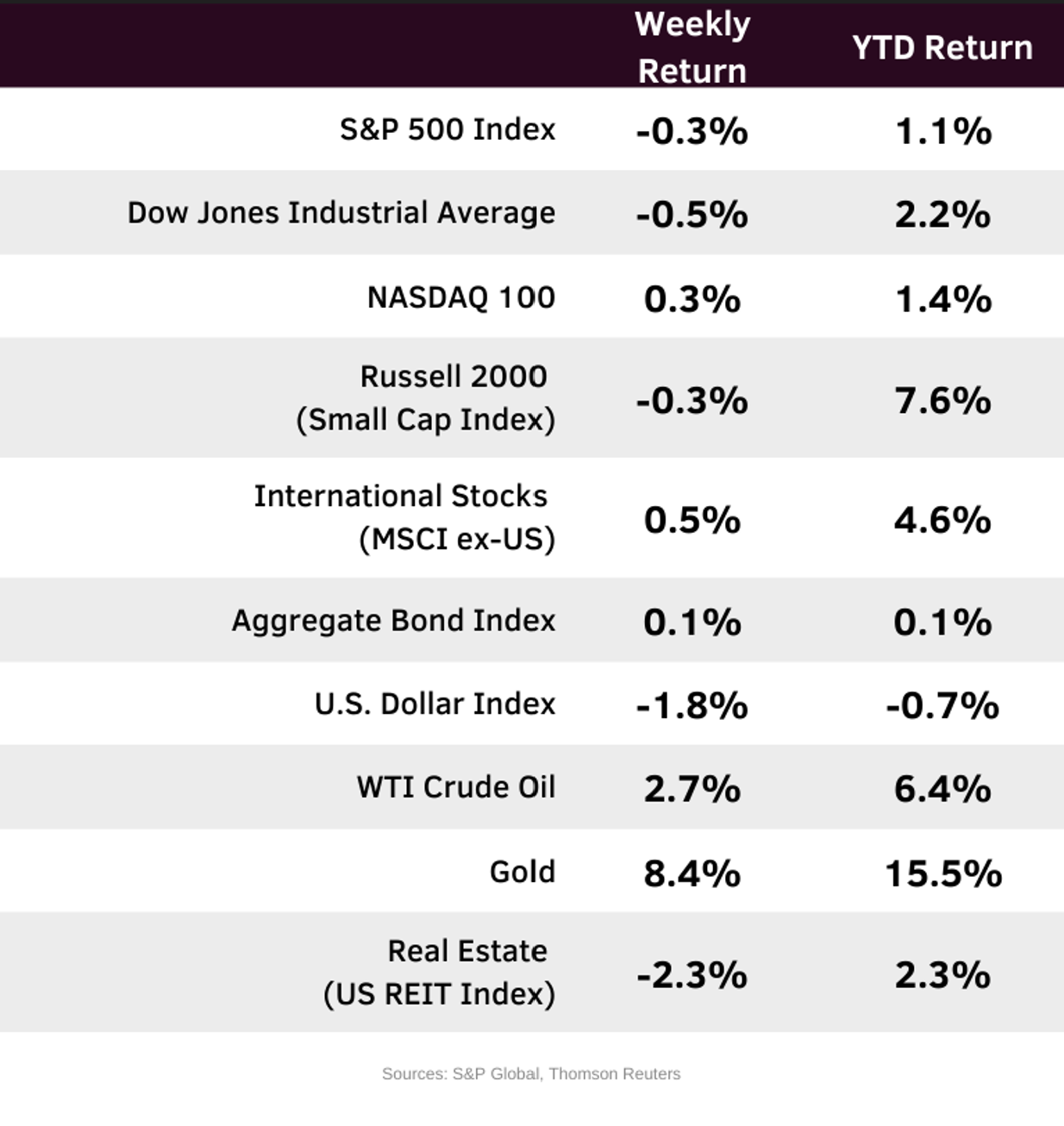
Geopolitical tensions around Greenland improved last week after some high-profile meetings at the World Economic Forum in Davos. A choppy week left stocks mixed with the S&P 500 and Dow Jones Industrials lower and the NASDAQ higher. For the week, the S&P 500 Index was -0.3%, the Dow Jones Industrials -0.5%, and the NASDAQ +0.3%. The Energy, Materials, and Health Care sectors led the S&P 500 Index for the week, while the Financials, Real Estate, and Utility sectors lagged. The 10-year U.S. Treasury note yield was 4.223% at Friday’s close versus 4.226% the previous week.
Greenland-related tariffs on several European nations scheduled to go into effect on February 1st were cancelled after President Trump met with NATO Secretary-General Mark Rutte and agreed on a “framework of a future deal” involving Greenland and broader Arctic security cooperation at the World Economic Forum.
Attention refocuses on domestic issues this week as the Federal Reserve meets to discuss monetary policy. The Fed is widely expected to keep the Federal funds rate at its current 3.50% to 3.75% target range. CME Fed funds futures currently show no changes in interest rates until the June policy meeting.
The earnings reporting season hits its stride this week with 103 companies in the S&P 500 Index scheduled to report earnings. Quarterly earnings are expected to grow by 8.2% with revenue growth of 7.8%. Full-year 2025 earnings are expected to grow by 12.4% with revenue growth of 7.2% and 2026 full-year earnings are expected to grow by 14.7% with revenue growth of 7.3%.
In our Dissecting Headlines section, we look at the potential economic impact of Winter Storm Fern.
Financial Market Update
Dissecting Headlines: Winter Storm Fern
Winter Storm Fern impacted almost half the United States over the weekend. Estimates vary widely but the total impact of the storm is estimated between $25 billion and $100 billion. The lower figure focuses on direct damage to property, infrastructure, and travel-related losses. The larger figure also includes lost wages, lost business activity, over time, and emergency management costs. Total damages look to be lower than the 2021 storms which hit mainly Texas and the Mid-South.
The large travel disruptions from the storm can be seen as air lines cancelled over 10,000 flights this past weekend. Surface travel and freight movement also saw widespread delays. Well over 800,000 customers lost power over the weekend with wholesale electricity and natural gas prices spiking well over typical seasonal levels. Continued below freezing temperatures across much of the United States into this week are likely to continue to strain utility services.
Since we are early in the quarter, the storm is not expected to have a negative impact on GDP. The total cost of the storm, even at the high end, equates to less than 1.5% of a single quarter’s GDP, and much of the monetary costs, such as travel and consumer spending, are more delayed rather than lost, and likely made up over the remainder of the quarter.