

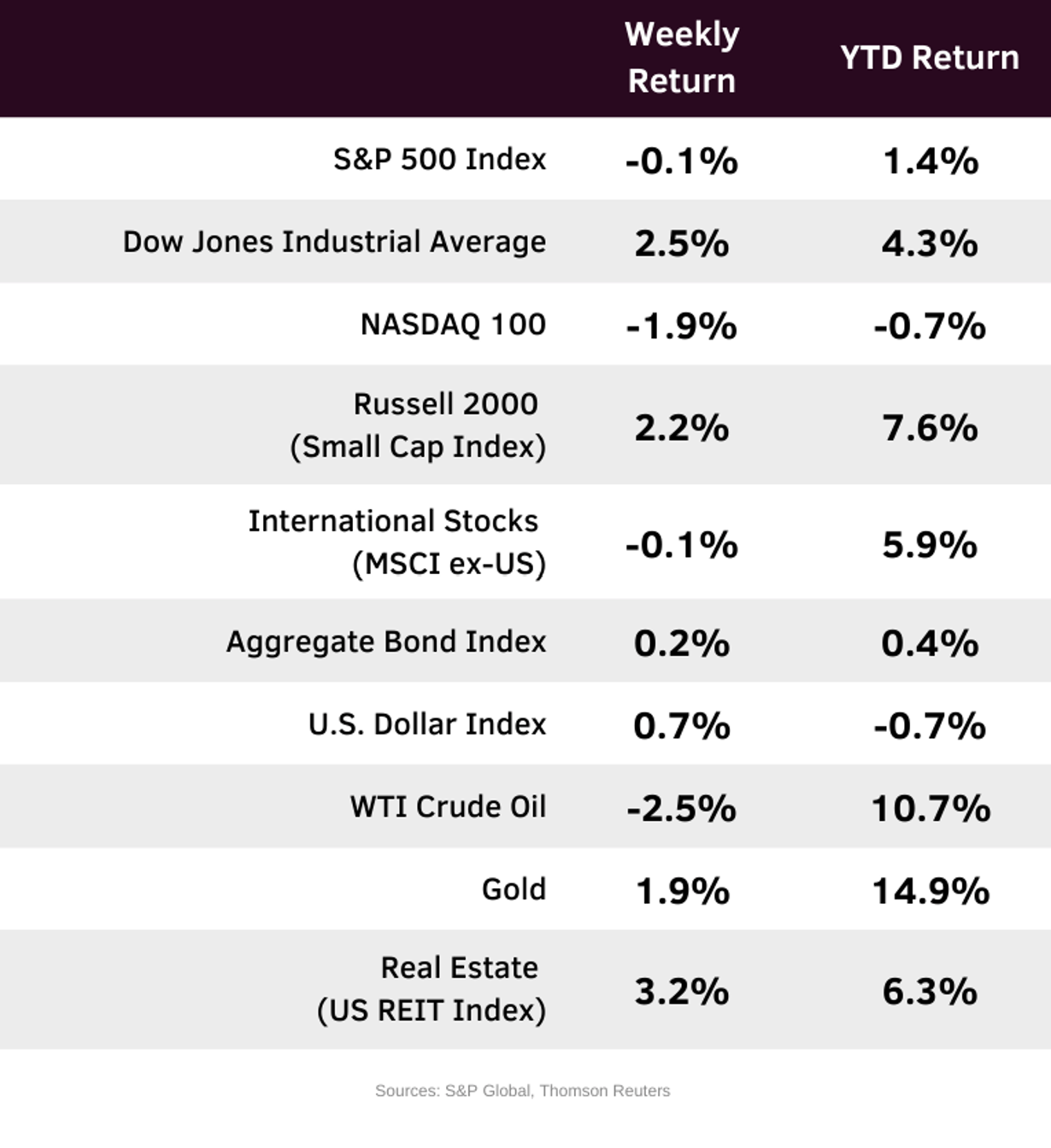
Concerns over large AI-related capital expenditure announcements rattled technology stocks. This pressured the NASDAQ, whereas the Dow Jones Industrial Average eclipsed 50,000 for the first time in its history. For the week, the S&P 500 Index was -0.1%, the Dow Jones Industrials +2.5%, and the NASDAQ -1.9%. The Consumer Staples, Industrial, and Energy sectors led the S&P 500 Index for the week, while the Consumer Discretionary, Communication Services, and Technology sectors lagged. The 10-year U.S. Treasury note yield was 4.204% at Friday’s close versus 4.257% the previous week.
Technology companies focused on building out their AI-related infrastructure have announced a collective $650 to $700 billion level of spending for 2026. This spending on data centers, chips, and other necessary compute infrastructure worried some investors about the return on that investment. Markets calmed on Friday after Nvidia CEO Jensen Huang said the build out was both sustainable and appropriate to advance the capabilities of AI in the economy. Ironically, Nvidia was added to the Dow Jones Industrial Average in late 2024 and Huang’s comments also helped the Dow close above 50,000 for the first time on Friday.
The partial U.S. government shutdown was short-lived, but one casualty last week was a delay in the release of the January Employment Report. It has been rescheduled for this Wednesday. This week we also get data on inflation with the January Consumer Price Index (CPI) report scheduled for Friday.
We are past the halfway point in the quarterly earnings cycle. This week 78 companies in the S&P 500 Index are scheduled to report earnings. Quarterly earnings are expected to grow by 13.0%. This is a second consecutive week of upward revision versus 11.9% last week and 8.2% two weeks ago. Quarterly revenue growth is expected at 8.8%, also a second week of upward revision versus 8.2% last week and 7.8% two weeks ago. Full-year 2025 earnings are expected to grow by 13.5% with revenue growth of 7.4% and 2026 full-year earnings are expected to grow by 14.1% with revenue growth of 7.3%.
In our Dissecting Headlines section, we look at spending for both the Super Bowl and Valentine’s Day.
Financial Market Update
Dissecting Headlines: Love to Spend
Between the Super Bowl and Valentine’s Day, Americans have good excuses to spend some money in February. According to the National Retail Federation (NRF) and Prosper Insights 2026 Super Bowl spending survey, Americans are projected to spend about $20.2 billion on food, drinks, apparel, decorations and other game-day purchases this year, with an average of roughly $94.77 per person. Average food costs for a Super Bowl party are about 1.6% higher year-over-year, with beer, wine, shrimp, and beef all higher, while chicken wings, tortilla chips, avocados, and frozen pizzas are lower.
It’s not just football fans spending money. The advertising cost for a 30-second television spot on the broadcast of the Super Bowl averaged around $8 million for 2026 with some companies paying up to $10 million or more for premium spots. Those high ticket advertising slots do get attention, with the projected viewership of this year’s Super Bowl at around 127.7 million people.
The love of spending continues this week with Valentine’s Day. NRF and Prosper Insights are forecasting consumer spending on Valentine’s Day to reach a record $29.1 billion, which surpasses the previous record from 2025 of $27.5 billion. Individual spending is expected to be $199.78 on gifts, another record from the previous record of $196.31 in 2020.
Fifty-five percent of consumers surveyed said they plan to celebrate Valentine’s Day this year. Most plan to purchase candy, followed by flowers, greeting cards, an evening out, and jewelry. However, the most money spent is expected on jewelry at $7.0 billion, followed by an evening out at $6.3 billion, clothing at $3.5 billion, and flowers at $3.1 billion.