

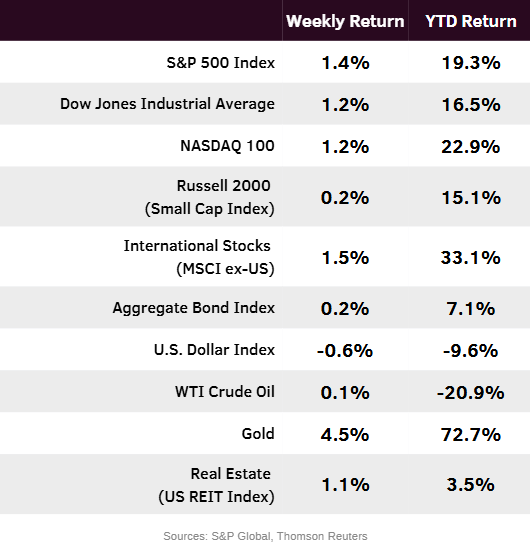
Stocks head into the final week of trading with double-digit gains for the year. Last week, the S&P 500 Index was +1.4 %, the Dow Jones Industrials +1.2%, and the NASDAQ +1.2%. The Materials, Technology, and Financial sectors led the S&P 500 Index for the week, while the Consumer Staples, Consumer Discretionary, and Health Care sectors lagged. The 10-year U.S. Treasury note yield was 4.129% at Friday’s close versus 4.151% the previous week.
The first report on third quarter GDP showed 4.3% growth versus 3.0% consensus, and versus the final second quarter reading of 3.8%. Consumer spending, higher differential between exports and imports, and higher government spending all contributed to higher economic growth for the quarter.
For the first half of 2026, CME Fed funds futures are currently forecasting a single 0.25% reduction in the Fed funds rate at its March meeting.
Fourth quarter earnings for the S&P 500 Index earnings are expected to grow by 8.3% with revenue growth of 7.6%. Full-year 2025 earnings are expected to grow by 12.3% with revenue growth of 7.0%. Looking ahead, current expectations for 2026 full-year earnings are 15.0% with revenue growth of 7.2%.
In our Dissecting Headlines section, we look at the forecast for higher tax refunds.
Financial Market Update
Dissecting Headlines: Tax Refunds
Data from the Tax Foundation shows that 2025 tax returns should see larger refunds than in recent years. The average tax refund for 2025 is expected at $3,800 versus $3,052 in 2024 and $3,004 in 2023. The larger refunds are due to the One Big Beautiful Bill Act, which reduced individual income taxes for 2025 by an estimated $144 billion. The IRS did not adjust withholding tables after the law passed mid-year, so most individuals continued to withhold taxes at the same rate as the start of the year versus adjusting to the changes in the Act. Most taxpayers will receive the difference when they file their 2025 tax returns in 2026.
The $144 billion tax reduction comes from several major changes in the Bill to include an increase in the child tax credit, increase in the standard deduction, the state and local tax deduction increase, the new additional deduction for seniors, the new auto loan interest deduction, the new deduction for tip income, and the new deduction for overtime income. Additional business deductions for bonus depreciation, full expensing for research and development costs, temporary expensing for manufacturing structures, and a more generous business interest deduction also contribute to individual tax returns of pass-through business owners.
For 2026, withholding tables will adjust and taxpayers should receive higher take-home pay, creating a smoother impact across the year. The 2025 refunds along with lower withholding in 2026 should provide some support to consumer spending in what has been a struggling labor market.