

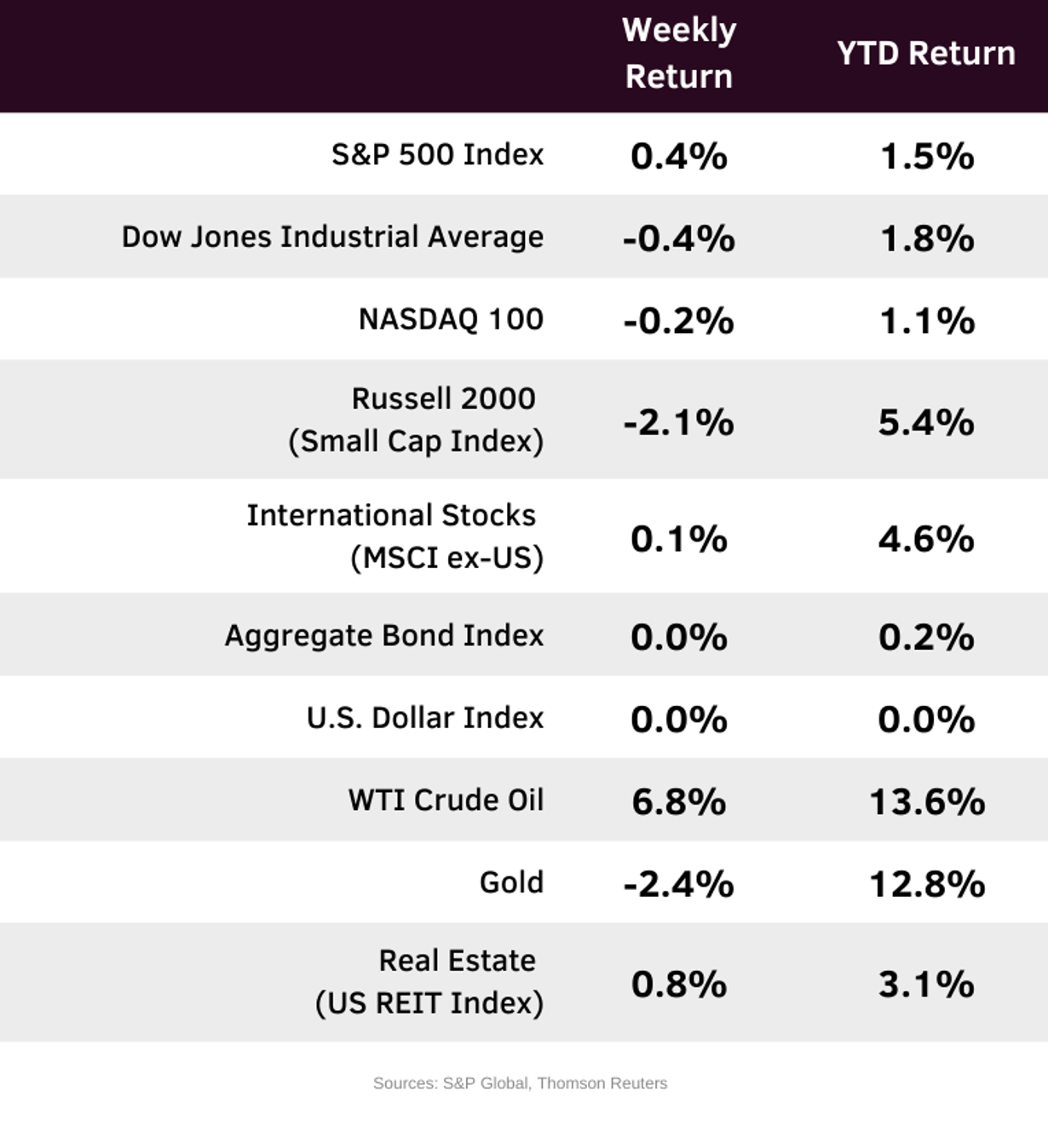
Markets absorbed a lot of corporate earnings results last week and finished mixed. For the week, the S&P 500 Index was +0.4%, the Dow Jones Industrials -0.4%, and the NASDAQ -0.2%. The Communication Services, Energy, and Utility sectors led the S&P 500 Index for the week, while the Health Care Consumer Discretionary, and Materials sectors lagged. The 10-year U.S. Treasury note yield was 4.257% at Friday’s close versus 4.233% the previous week.
As expected, the Federal Reserve held the Fed funds rate at its current 3.50% to 3.75% target range during its January policy meeting. CME Fed funds futures currently show no changes until the June policy meeting. The bigger Federal Reserve news came later in the week with President Trump nominating Kevin Warsh to be the next Fed Chairman when current chairman Jerome Powell’s term ends in May.
The next report on the labor market is scheduled for this Friday with the January Employment Situation Report.
The U.S. government is in a partial shutdown as of January 31st as all appropriations legislation was not completed by the deadline. Discussions are on-going and the remainder of appropriations are expected this week and the government fully re-opened.
The earnings reporting momentum stays robust this week with 127 companies in the S&P 500 Index scheduled to report earnings. Quarterly earnings are expected to grow by 11.9%, which is a large upward change from 8.2% last week, with revenue growth of 8.2%, also an upward revision from 7.8% last week. Full-year 2025 earnings are expected to grow by 13.2% with revenue growth of 7.3% and 2026 full-year earnings are expected to grow by 14.3% with revenue growth of 7.3%.
In our Dissecting Headlines section, we look at President Trump’s Federal Reserve chairman nomination.
Financial Market Update
Dissecting Headlines: Fed Chair Nominee
President Trump nominated Kevin Warsh to be the next chairman of the Federal Reserve when current chairman Jerome Powell’s term as chairman ends in May. Warsh previously served as a Fed governor from 2006 to 2011.He was also an economic adviser in the Bush administration. He is seen as a less polarizing pick than more Trump aligned candidates Kevin Hassett, the current White House National Economic Council Director, or Christopher Waller, a current Fed governor.
President Trump’s criticism of the Federal Reserve for not being more proactive in lowering interest rates likely drove his decision on Warsh , who has argued that current interest rate levels are constraining growth and that the Fed should have a more accommodative policy stance. In the past, Warsh has been more hawkish and critical of the Fed’s large balance sheet.
The nomination now goes to the Senate Banking Committee who will hold hearings with Warsh, and then the full Senate for confirmation.